
Health Care
Hospital prices have soared. Government policy helps explain why.
Curtis Shelton | September 23, 2026
Economist Mark Perry has (deservedly) gotten a lot of attention for this chart, and the pattern is hard to miss. Many goods and services that have become less expensive operate in relatively competitive markets. Those experiencing some of the largest price increases, including hospital care, college tuition, and child care, are sectors where the government plays a significant role in financing, regulating, or both.
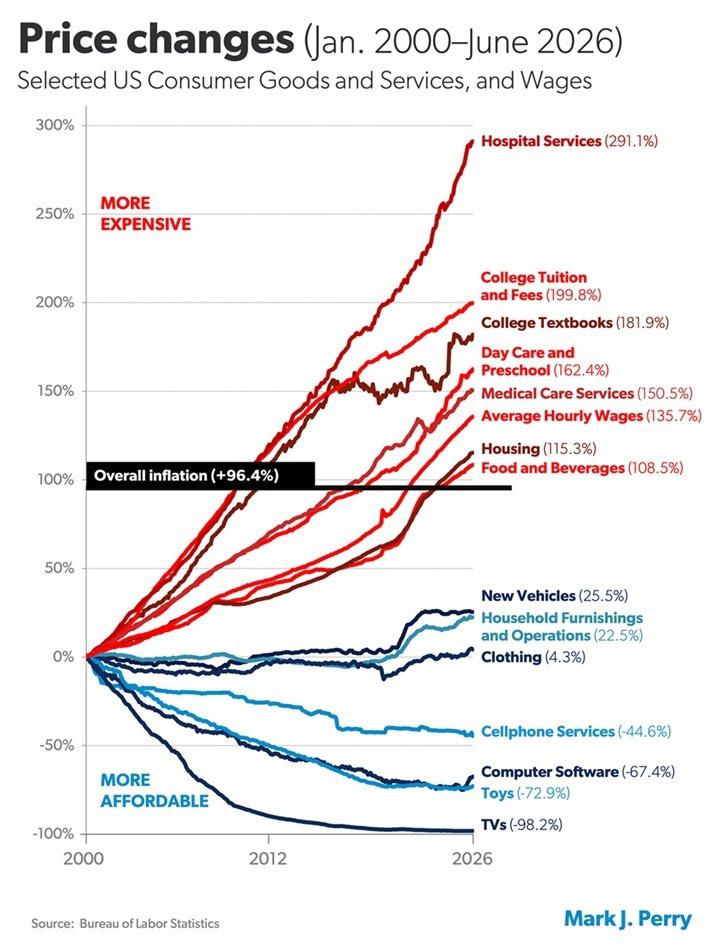
Hospital care provides a particularly useful example because many of the policies contributing to higher prices can be identified directly.
One of the clearest examples is how Washington pays for care. Medicare can reimburse hospitals substantially more than independent physicians or ambulatory surgery centers for providing the same outpatient service. For example, Medicare reimbursement for a stress test performed in a hospital outpatient department can be about 2.5 times the reimbursement in a lower-cost setting.
That creates a powerful incentive for consolidation. When a hospital acquires an independent physician practice and converts it into a hospital outpatient department, it may begin receiving higher reimbursement for essentially the same services.
The numbers reflect that incentive. The share of physicians employed by hospitals increased from 26 percent in 2012 to more than 55 percent in 2024. A 2021 study estimated that Medicare payments were $114,000 higher per physician each year when the physician was integrated into a hospital system rather than practicing independently.
Oklahoma hospitals have billions in assets while prices keep rising.
The same trend can be seen among hospitals themselves. By 2022, 68 percent of U.S. hospitals belonged to a larger hospital system, compared with 53 percent in 2005. Hospital mergers within the same market have been associated with price increases of 20 to 50 percent. Even mergers involving hospitals in different geographic markets have been associated with increases of 6 to 17 percent, with little evidence of corresponding improvements in quality.
Tax policy provides another advantage. Most American hospitals operate as nonprofit organizations and receive significant federal, state, and local tax benefits.
An analysis by EY commissioned by the American Hospital Association estimated that nonprofit hospitals received $54.4 billion in federal, state, and local tax benefits in 2022. In exchange, nonprofit hospitals are expected to provide a “community benefit,” but that term is broadly defined. It can include not only traditional charity care but also unreimbursed Medicaid costs, education, research, community-building activities, and other expenses.
Meanwhile, hospitals' total margins reached 6.5 percent in 2024, while investment income reached $18 billion. Oklahoma's nonprofit hospital systems also hold significant assets. In their latest Form 990 filings, Saint Francis Hospital in Tulsa reported nearly $4.4 billion in total assets, while INTEGRIS Health in Oklahoma City reported more than $2.2 billion.
Another important factor is who actually pays for hospital care. Only about 2 percent of hospital revenue comes directly from patients. Most hospital spending is instead paid through private insurance or government programs such as Medicare and Medicaid.
That separates consumers from the price of the service. Patients have less incentive—and often little ability—to compare prices, while hospitals face less pressure to compete based on price.
Government payment policies can further weaken that connection. Although Medicaid base-payment rates are generally below Medicare rates, supplemental and state-directed payments can push total Medicaid payments above Medicare rates.
Taken together, these policies help explain the trend shown in Perry’s chart. Hospital services increased about 291 percent from 2000 through 2026.
In many other industries, technological improvements and competition have pushed prices down while improving quality. Health care has benefited from technological advances, but hospital prices have continued moving in the opposite direction.
Hospital care operates under a very different set of incentives than the products on Perry's chart that have become less expensive. Those incentives help explain why hospital prices have moved so differently from much of the rest of the economy.

Curtis Shelton
Policy Director
Curtis Shelton currently serves as the policy director for OCPA with a focus on fiscal policy. Curtis graduated Oklahoma State University in 2016 with a Bachelors of Arts in Finance. Previously, he served as a summer intern at OCPA and spent time as a staff accountant for Sutherland Global Services.