
Education
Momentum builds to revive Mississippi-style reading reform in Oklahoma
Jonathan Small | December 1, 2025
Efforts to address Oklahoma’s school-produced illiteracy crisis gained further momentum recently as officials with the Oklahoma State Chamber called for lawmakers to adopt a Mississippi-style reading law. That will require early intervention for struggling readers and a mandate that children repeat the third grade if they do not meet basic literacy standards.
According to National Assessment of Educational Progress (NAEP) tests, only 23 percent of Oklahoma fourth-grade students were proficient or advanced in reading in 2024. That ranks 49th in the nation.
In contrast, Mississippi ranks ninth.
The business community understands you cannot have robust economic growth if much of your workforce struggles to comprehend what they read.
Oklahoma was on the path to achieving the same top-10 status that Mississippi holds today, but pushback from status-quo forces in education derailed those efforts and created a lost generation.
Between 2011 and 2014, Oklahoma’s reading law was similar to the Mississippi law now hailed as a national model. We required measurement of student progress and swift intervention for struggling readers, and barred social promotion of third-grade students who were far below grade level in reading.
Our state’s NAEP score on fourth-grade reading increased to 222 in 2015, surpassing the national average. But outcomes plunged after the retention law was largely gutted. By 2024, the average NAEP reading score fell to 207, which indicates Oklahoma students are now roughly 1.5 years behind their 2014 peers.
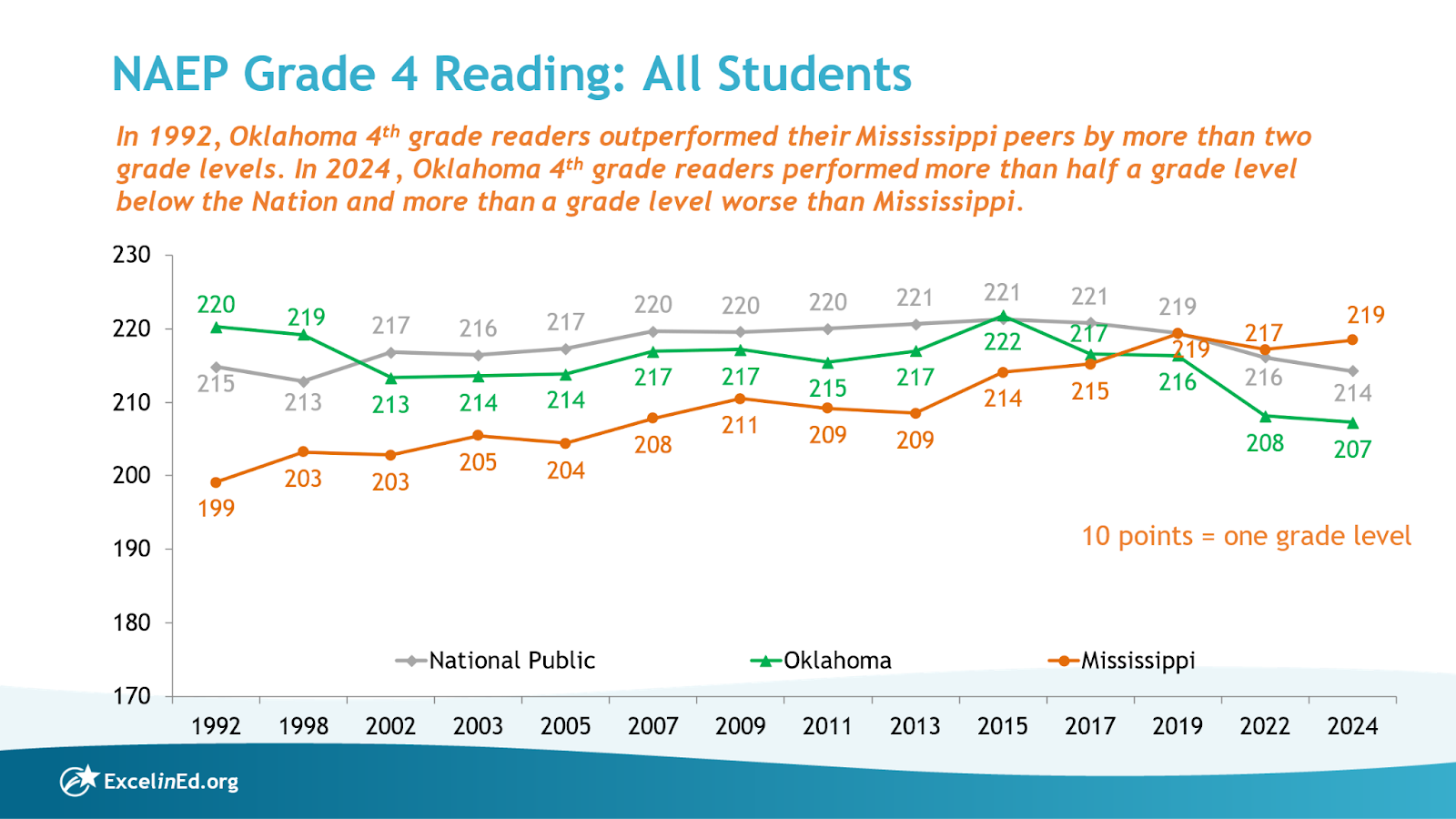
Some critics are now trying to rewrite history, claiming that the gutting of Oklahoma’s reading law was a cost-cutting measure amid the oil bust of 2016 to 2018. In reality, officials began gutting the law in 2014 and made no mention of “savings.”
Furthermore, Oklahoma public schools have been flooded with cash since 2018, but reading outcomes have continued to decline at an astounding rate.
According to financial data reported to the state’s Oklahoma Cost Accounting System (OCAS), Oklahoma public schools received $9.6 billion in new revenue in the 2023-2024 school year (the most recent for which full data are available), an increase of $3.3 billion compared to $6.3 billion in revenue during the 2017-2018 school year.
On a per-student basis, Oklahoma public-school revenue surged 51 percent from the 2017-2018 school year to the 2023-2024 school year, reaching $13,736 per pupil.
To further increase funding without changing our approach to reading is to do the same thing over and over again, hoping for different results. It’s an embrace of continued failure.
Critics also claim that banning social promotion will create overcrowded third-grade classrooms where teachers will be overwhelmed. The same claims were made in Mississippi and proved false.
The path forward is clear. If Oklahomans truly want children to learn to read, we must adopt the Mississippi plan once again—and this time, we must stick to it.
Jonathan Small
President
Jonathan Small, C.P.A., serves as President and joined the staff in December of 2010. Previously, Jonathan served as a budget analyst for the Oklahoma Office of State Finance, as a fiscal policy analyst and research analyst for the Oklahoma House of Representatives, and as director of government affairs for the Oklahoma Insurance Department. Small’s work includes co-authoring “Economics 101” with Dr. Arthur Laffer and Dr. Wayne Winegarden, and his policy expertise has been referenced by The Oklahoman, the Tulsa World, National Review, the L.A. Times, The Hill, the Wall Street Journal and the Huffington Post. His weekly column “Free Market Friday” is published by the Journal Record and syndicated in 27 markets. A recipient of the American Legislative Exchange Council’s prestigious Private Sector Member of the Year award, Small is nationally recognized for his work to promote free markets, limited government and innovative public policy reforms. Jonathan holds a B.A. in Accounting from the University of Central Oklahoma and is a Certified Public Accountant.