
Law & Principles
Republicans hold Oklahoma’s statewide offices as Democrats make House gains
Ray Carter | November 4, 2026
Republican candidates easily won all statewide races in Oklahoma in this year’s midterm elections, even as Democrats prevailed in many other states across the country, including some traditionally conservative states.
Republicans also maintained their supermajorities in both chambers of the Oklahoma Legislature, although Democrats made some gains in the Oklahoma House of Representatives.
“Oklahoma voters sent a clear message at the ballot box today, sweeping all statewide offices and reaffirming a supermajority in the state House,” said Oklahoma House Speaker Kyle Hilbert, R-Bristow. “Despite the national trends, tonight’s results demonstrate that Oklahomans continue to believe in the conservative principles, priorities, and leadership that have helped move our state forward. I’m grateful to every Oklahoman who took the time to vote and to the candidates who stepped forward to serve their communities.”
Mike Mazzei, the Republican candidate for governor, carried 73 of Oklahoma’s 77 counties and received 52 percent of the vote.
His opponent, Democrat Cyndi Munson, carried four counties and received just under 46 percent of the vote.
Mazzei carried 73 of the state’s 77 counties and campaigned on conservative priorities including tax restraint, education reform, and school choice, while Munson supported eliminating Oklahoma’s Parental Choice Tax Credit.
In a statement posted to social media, Mazzei said he was “humbled by the trust” voters had placed in him and declared he is now “ready to get to work.”
“I’ve said from the very beginning that Oklahoma has unlimited potential,” Mazzei said. “Now we get to prove it. We’re going to build a state government that respects the money you work hard to earn, delivers real results for our kids in the classroom, and gives the next generation every reason to build their future right here at home.”
Munson’s strongest showing was in Oklahoma County, where she received nearly 62 percent of the vote. Nearly all statewide Democratic candidates received a majority of the vote in Oklahoma County, including the Democratic U.S. Senate candidate, N’Kiyla Jasmine Thomas, who publicly identified with the Democratic Socialist wing of the party.
In a brief statement posted to social media, Munson thanked her supporters.
“We may have lost an election, but we haven’t lost our power to change Oklahoma,” Munson said.
School choice was a major difference between Mazzei and Munson.
Mazzei supported school-choice policies that allow Oklahoma families of all incomes to access the private school of their choice, while Munson opposed those policies, vowing to eliminate the Oklahoma Parental Choice Tax Credit program.
Had Munson succeeded in eliminating the program, tens of thousands of Oklahoma children would have lost access to the tax credit, including nearly 23,000 children from low-income and middle-income families, among them 3,436 children on welfare programs.
Tommy Schultz, CEO of AFC Victory Fund, cited Mazzei’s pro-education stance as a factor in his victory.
“Oklahoma families have access to educational opportunities that did not exist just a few years ago, and Mazzei has committed to protecting that access,” Schultz said. “As Oklahoma prepares for a new administration, families can rest assured that the governor-elect is committed to supporting educational freedom for students across the state.”
Munson’s share of the vote was about four percentage points higher than the norm for an Oklahoma Democratic gubernatorial candidate in every race since the 2010 election, driven primarily by her support in Oklahoma and Tulsa counties, the state’s two urban centers. In the 2010, 2014, 2018, and 2022 races, the Democratic gubernatorial candidate in Oklahoma drew between 40 percent and 42 percent of the vote.
However, the raw number of votes cast for Munson was only 2.1 percent greater than the number received by the Democratic Party’s gubernatorial nominee in 2018, the last year that no incumbent was running for governor.
In 2027, Republicans will retain veto-proof supermajorities in both chambers of the Oklahoma Legislature, holding 75 of 101 House seats and 40 of 48 Senate seats.
Overall voter turnout in the 2026 election was lower in Oklahoma than in the two most recent gubernatorial elections. This year’s turnout was a little under 46 percent of registered voters, while the 2022 elections drew 50 percent and the 2018 governor’s race drew 56 percent of voters.
Overall, there were 70,307 fewer votes cast in this year’s governor’s race than in 2018, the most recent open-seat race for the position.
Going into the 2026 elections, Republicans held 81 seats in the Oklahoma House of Representatives while Democrats held 18 with two vacancies in traditionally Democratic seats.
Democrats flipped six seats, primarily in urban areas. Democratic challengers defeated Republican incumbent state Reps. T.J. Marti of Broken Arrow, Eric Roberts of Oklahoma City, Tammy West of Oklahoma City, Max Wolfley of Oklahoma City, and Marilyn Stark of Bethany, and Democrats also narrowly won an open seat in the Lawton area.
Even so, Republicans will still hold a veto-proof supermajority in the Oklahoma House of Representatives with 75 seats to 26 held by Democrats when the Oklahoma Legislature convenes for the 2027 session.
In the Oklahoma Senate, Republicans held 40 seats before the election while Democrats held only eight. That margin was unchanged after this year’s voting concluded.
Governor Kevin Stitt issued a brief statement congratulating Mazzei.
“Mike is a businessman who understands that every dollar the government spends belongs to the taxpayer,” Stitt said. “Electing business leaders back-to-back is how we build on Oklahoma’s incredible momentum from the past eight years.”
Stitt noted that during his two terms, Oklahoma has increased annual state funding for public education from $2.91 billion to $4.2 billion; cut $1.6 billion in taxes; built state savings projected to reach approximately $4.5 billion in fiscal year 2027, up from $451.6 million in fiscal year 2019; reduced the developmental disability services waiting list by nearly 66 percent and shortened the reported wait from 13 years to approximately 13-to-14 months; and reduced the number of state employees.
“Over the last eight years, I’ve pushed state agencies and the Legislature to keep budgets flat and make government more efficient. All the while, we’ve delivered better results for taxpayers,” Stitt said. “We’re handing the next administration a strong foundation, and I’m excited to see Mike build on it.”
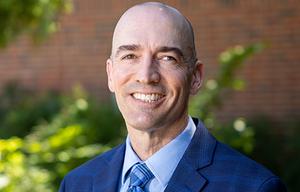
Photo credit: mikeforok.com
Ray Carter
Director, Center for Independent Journalism
Ray Carter is the director of OCPA’s Center for Independent Journalism. He has two decades of experience in journalism and communications. He previously served as senior Capitol reporter for The Journal Record, media director for the Oklahoma House of Representatives, and chief editorial writer at The Oklahoman. As a reporter for The Journal Record, Carter received 12 Carl Rogan Awards in four years—including awards for investigative reporting, general news reporting, feature writing, spot news reporting, business reporting, and sports reporting. While at The Oklahoman, he was the recipient of several awards, including first place in the editorial writing category of the Associated Press/Oklahoma News Executives Carl Rogan Memorial News Excellence Competition for an editorial on the history of racism in the Oklahoma legislature.